
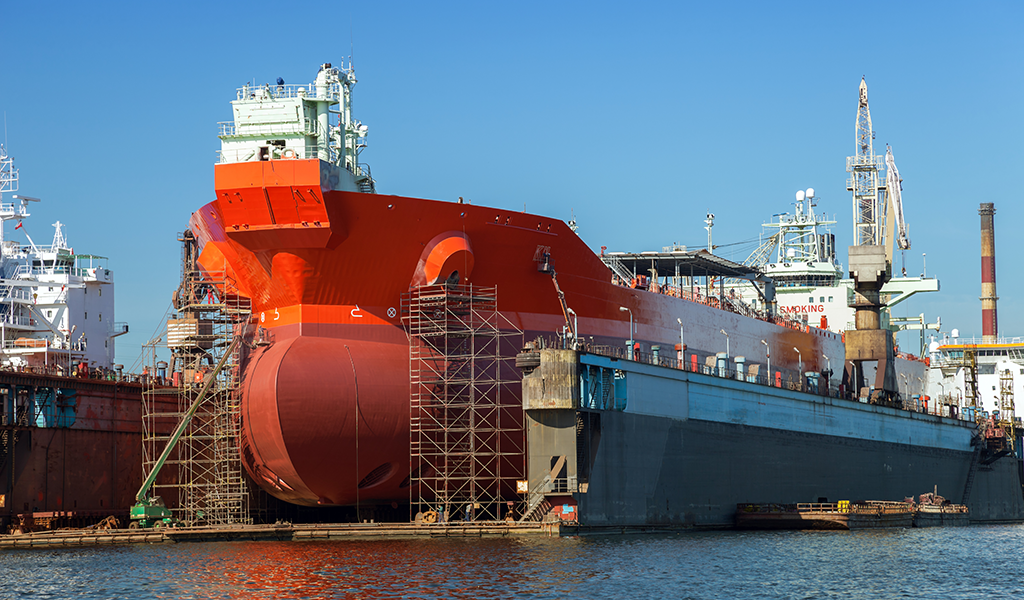
Two intense years in the European research project SEUS are now behind me. Our shared goal: to drive the digitalization of European shipbuilding forward. The need for this remains as pressing as ever. The EU continuously funds research and development projects in the maritime sector to strengthen Europe’s position in global competition – which is vital for survival given the low-wage countries and extensive subsidies in markets outside of Europe.
Although European quality is highly valued in the maritime industry, cost pressures are forcing even this traditional sector to achieve massive efficiency gains and optimize its processes. This is exactly where we at CONTACT came in: as an integral partner in this research and a driving force behind the transformation, our goal was to provide the crucial data backbone required for successful digitalization.
A floating city – and what it has to do with PLM
First, we had to dive deep into the complex requirements and processes of shipbuilding to truly understand them. Through intensive discussions with shipyards, in-depth analyses, and a thorough review of the current state of research, we were able to build a comprehensive foundation of knowledge.
What really impressed us was the meticulous care with which the shipyards in this project process enormous volumes of information, collaborate securely across disciplines, and confidently navigate strict classification requirements. This involves tens of thousands of pages of test reports, calculations, manuals, and technical specifications.
What is being built here is nothing less than a small, self-sustaining city floating across the oceans – a construction process that never fails to fascinate. This is just as true for classic cargo and container vessels as it is for highly specialized cable-laying vessels, complex research ships, or military vessels.
The data backbone: connecting the maritime world
The greatest challenge lies in efficiently managing and transparently controlling the diverse information generated across all disciplines, engineering phases, and construction stages. To address this, we developed a data model specifically tailored to shipbuilding that connects all types of information, including project schedules, CAD models, simulation results, engineering designs, and supplier contracts.
Viewing the ship as a “physically massive and complex system” is crucial here. This means that instead of a few individuals keeping track of the entire vessel, a large number of engineers divide the work into smaller areas of responsibility. Depending on the engineering task and phase, they look at the ship from different angles. For example, while designing the propulsion unit focuses primarily on the architecture of that specific system, designing the ship’s hull centers on spatial layout.
A traditional product structure, which hierarchically organizes parts and assemblies based on how they fit together, cannot meet these demands. There is not one “true” product structure; instead, there are multiple viewpoints: systemic, spatial, production-centric, and module-oriented.
Many shipyards and engineering offices use a centralized system structure, as a large portion of the work involves designing, engineering, and integrating systems of all kinds. In Europe, the “SFI Group System” has established itself as the de facto standard for this purpose. This three-level standard catalog contains 4,080 entries for systems and subsystems that can be found in any type of vessel.

Our IT architects designed a data model that systematically maps these other perspectives around this standard (for details, see our paper on Zenodo). In early-stage ship design, systems are first roughly dimensioned using placeholders. For example, you might specify that an engine is needed, but not yet which particular model. These placeholders – referred to below as “items” – are organized according to the SFI Group System catalogs.
As development progresses, we link these items to additional structures that form the basis of the other perspectives. Using the previous propulsion example, this could mean selecting a specific engine for that item. In addition to relevant documents, requirements, specifications, and project tasks, a CAD model can also be linked. Our partner Cadmatic enables this through a deep integration of CAD tools.
Although the project is not yet complete, a shipbuilding-specific PLM backbone, the flexible and modular CONTACT Elements platform, and the deep integration with marine CAD software already form a solid foundation for further application-level development. The sheer scale of these projects highlights why this is so critical: if even ten documents, such as specifications, CAD files, analyses, manuals, and test reports, are associated with each of the up to 4,000 possible subsystems, you quickly end up with massive amounts of data that would be uncontrollable without structured management.
On top of that, each of these documents goes through its own lifecycles, reviews, and approvals that must be coordinated both internally and with external partners. Seamless, traceable document management across corporate boundaries is therefore absolutely vital, and thanks to an extension in CONTACT Elements for shipbuilding, it is fully achievable.
To learn more about the background and the partners involved, check out the SEUS Annual Report 2025.