Sustainability as a competitive edge: one step ahead with PLM

Sustainable thinking is no longer a “nice-to-have” – regulations and customer demands have made it a central pillar of modern innovation. A growing number of companies are realizing that ecological responsibility and economic success can go hand in hand. This is especially evident in product development: where cost-effectiveness used to dominate, sustainability has emerged as another key factor.

The right balance between economic and ecological aspects

While cost and efficiency remain crucial, staying competitive in the future requires taking the environmental balance into account when making business decisions. The challenge lies in finding the right balance between economic performance and ecological responsibility. This is most successful when sustainability is considered from the very beginning – at the design stage – rather than at the very end.

Why the product development process is crucial

Around 80% of a product’s environmental impact is already determined during the development phase. Decisions about materials, manufacturing processes, energy use, and recyclability made during this stage play a decisive role. Leveraging reliable and transparent data in the decision-making process enables companies to lower the environmental impact of their products.

LCA vs. PCF: Two key terms briefly explained

Anyone involved in sustainable product development will inevitably encounter these two concepts:

  • Life Cycle Assessment (LCA): The assessment of a product’s environmental impact throughout its lifecycle, from raw material extraction to disposal.
  • Product Carbon Footprint (PCF): The environmental footprint of a product, expressed in CO₂ equivalents. The PCF is often part of a broader LCA.

Implementing sustainability directly in the PLM system

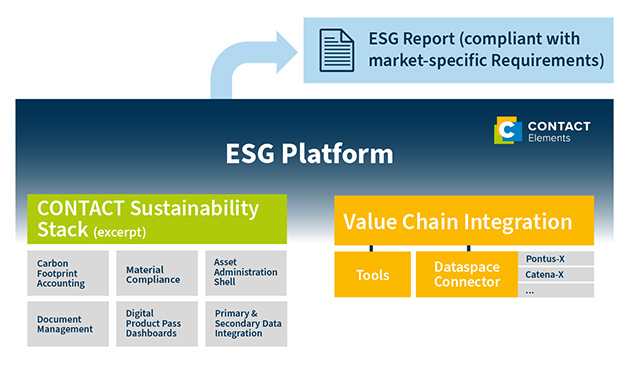
CONTACT’s sustainability solution allows this environmental data to be recorded and used directly in CIM Database PLM. This enables a systematic evaluation of materials, processes, and product structures. Whether entered manually or imported automatically from environmental databases, a product’s environmental impact can be analyzed and improved directly within the system.

Asset Administration Shell: a key to data exchange in the supply chain?

Sustainability is not a solo effort. Especially for complex products involving multiple suppliers, effective data exchange is crucial. This is where the concept of the Asset Administration Shell (AAS) comes into play – a standardized representation of digital twins for industrial components.

Using AAS submodels like the Carbon Footprint, companies can communicate environmental data in a standardized way, both internally and externally. This creates a seamless data foundation across the entire value chain. Using submodels like the Carbon Footprint, companies can communicate environmental data in a standardized way – both internally and externally, enabling them to integrate data from purchased components.

Three key takeaways:

  1. Sustainability starts with engineering, where crucial decisions are made.
  2. Standardized data formats enable the integration of environmental data into the product lifecycle.
  3. With IT tools like CONTACT Elements Sustainability Cloud, companies can not only plan eco-friendly operations but also implement sustainability early in the development process.

Conclusion

Developing sustainable products is no longer a vision for the future – it’s a reality today. Companies that adopt the right tools at an early stage and rely on standardized processes gain not only ecological advantages but also economic benefits.

ISO 27001 & Cloud PLM: reliably protecting product data

Why certification should be considered when choosing a system

A PLM system stores a wide range of sensitive product data — from the first sketch to the finished product. What happens if this data falls into the wrong hands? Or if third parties manipulate the information?

Companies can avoid such risks using certified Cloud PLM software according to ISO 27001. The certification follows globally recognized standards that ensure information security at all times.

In this blog post, you’ll learn why ISO 27001 certification is an important criterion when selecting a cloud-based PLM system. You’ll also get an insight into the processes and methods certified providers use to protect your data.

What is ISO 27001 Certification?

ISO/IEC 27001 is an international standard that defines the requirements for an Information Security Management System (ISMS). An ISMS includes policies, procedures, and technical measures that systematically protect information within an organization.

The ISMS defines three security objectives:

• Confidentiality: Only authorized persons are allowed to access sensitive information. Measures like encryption, access control lists, and file permissions ensure confidentiality.

• Integrity: Only authorized persons can modify data. It must be ensured that unauthorized changes can be undone.

• Availability: Information must always be accessible to authorized users. Risks like power or network outages are taken into account.

Independent certification bodies carry out the ISO 27001 certification. Key requirements include:

• Risk assessment and management: Identification of potential threats and vulnerabilities.

• Security Policies: Establishing clear guidelines for handling information.

• Training: Raising awareness among employees about information security.

• Continuous improvement: Regular reviews and optimization of security measures.

Advantages of ISO 27001 Certification for Cloud Providers

1. Trustworthiness and Transparency

ISO 27001 certification shows that the cloud provider follows high security standards, handles data with maximum care, and proactively addresses potential risks.

2. Risk Minimization

Companies that store sensitive data in the cloud need adequate protection against cyberattacks, data loss, and unauthorized access. ISO 27001 certification proves that the provider has implemented effective protective measures.

3. Compliance and Legal Requirements

Since certified cloud providers already meet crucial security standards, it’s easier for customers to comply with data protection and security regulations such as the EU General Data Protection Regulation (GDPR).

4. Efficient Risk Management

ISO 27001 provides structured risk management processes. They help systematically identify, minimize, and address vulnerabilities early and reliably.

Conclusion

Cyberattacks caused economic damage of 266 billion euros in Germany alone in 2024. When selecting software such as Cloud PLM, IT security should be one of the key criteria. ISO 27001 certification signals to companies that their data is comprehensively protected. It follows reliable security standards and facilitates compliance with legal requirements.

The development and operation of cloud products based on CONTACT Elements meet the strict requirements of the ISO 27001 standard. This certification confirms that CIM Database Cloud meets the highest security standards and ensures effective management of information security risks.

Using SCIM in Cloud PLM Systems

Efficient User and Access Management in Product Lifecycle Management

As companies grow, drive innovation, and navigate staff changes, the number of user accounts naturally increases. Every tool — whether for customer management or team collaboration — requires its own user account. This poses a significant challenge for the IT department, as every request, such as adding new users or modifying permissions, consumes valuable resources. This effort can be minimized with SCIM (System for Cross-Domain Identity Management) — efficiently, securely, and user-friendly.
In this article, learn how SCIM facilitates the entire process of managing user data in Cloud PLM systems through automated identity lifecycle management.

What is SCIM?

SCIM is an open standard designed to facilitate the exchange and synchronization of user data and permissions across different applications and systems. It was developed to minimize administrative effort in managing user data while enhancing security.
SCIM allows organizations to manage user accounts centrally. Related information is automatically transferred to other applications, such as Cloud PLM systems.

Why is SCIM important for Cloud PLM Solutions?

Without an automated solution like SCIM, companies face two challenges when managing user data and access rights in Cloud PLM systems:
• High manual effort: Users must be created, updated, or deleted individually across multiple systems.
• Security risks: Outdated user accounts in PLM systems can create security vulnerabilities.

What are the Benefits of using SCIM in Cloud PLM Systems?

SCIM significantly reduces the effort required to manage user accounts. It seamlessly connects identity management systems with enterprise applications, eliminating the need to develop and maintain custom integrations.
This relieves the IT department and employees in other departments benefit from Single Sign-On (SSO). With a single login, they gain access to all necessary applications. This streamlines workflows and reduces password reset requests by up to 50%. By minimizing administrative tasks, more time is available for core tasks. Automated synchronization ensures that user data remains up-to-date and consistent across all systems.
Security also increases significantly in combination with Single Sign-On. Thanks to centralized SSO authentication based on OpenID Connect (OIDC), there’s no need to have a separate password for each account. This reduces security risks related to weak or reused passwords. Companies can enforce security policies more consistently and integrate new workflows or applications more easily. At the same time, they maintain full control over user accounts.

Can Companies use the SCIM Interface with CIM Database Cloud?

The SCIM interface is now available for CIM Database Cloud. It is part of the CIM Database Cloud infrastructure and does not incur additional licensing costs.

Conclusion

SCIM is a standard that automatically synchronizes user data and permissions across different systems. By integrating SCIM into Cloud PLM solutions, companies can streamline their processes, reduce security risks, and minimize administrative overhead.
Take advantage of the benefits of cloud-based PLM software now: CIM Database Cloud is the solution for end-to-end digital product development with an integrated SCIM interface.