How will the Data Act affect the industry?

Successful digital transformation requires access to data and its intelligent use. The EU has therefore defined a regulation that is intended to strengthen the European data market: the Data Act. Companies from traditional industries must adapt to it as soon as possible.

What is the Data Act?

The “Regulation on harmonised rules on fair access to and use of data” (Data Act) is a directive of the European Union that defines regulations regarding data access and use. It aims to create a fair, transparent framework for the exchange and use of data within the EU, thereby promoting innovation and increasing the competitiveness of European companies on the global data market.

The Data Act is a key component of the EU’s digital strategy. It was approved by the European Council on November 27, 2023 and came into force on January 11, 2024. Following a 20-month transition period, it is to be converted into directly applicable EU-wide law from September 12, 2025.

What is the motivation?

Data is a key resource in the digital economy. However, due to a lack of guidelines, legal requirements, and standards, a large part of the data generated remains unused, especially in industry.

Furthermore, we are currently observing a strong imbalance on the market: data is mostly owned by a small group of large companies. Compared to SMEs and start-ups, this gives them a considerable competitive advantage, which is reflected, for example, in one-sided contracts regarding data access and use.

To counteract this, the EU has developed the Data Act. It aims to democratize the market and create a balanced, fair data ecosystem. To this end, the EU has defined a legal framework ensuring that users of networked products or connected services can promptly access the generated data.

The objectives of the Data Act in a nutshell:

  • Clear rules for the use and exchange of data
  • Transparency and fairness within the data market
  • Protection of personal data
  • Secure data processing
  • Promotion of data-driven innovations
  • Increased competitiveness of EU companies

Who is affected by the Data Act?

The Data Act addresses companies, organizations, and individuals who

  • bring connected products to the market,
  • offer connected services,
  • as a data owner, share generated data with third parties,
  • receive data from data owners,
  • as a public institution, request data owners to share data, or
  • offer data processing services.

Persons who participate in data rooms and providers of applications that include smart contracts are also affected. Persons whose trade, business, or profession involves the implementation of smart contracts for others in connection with the execution of an agreement must also comply with the Data Act.

Which tasks result from the Data Act?

The Data Act imposes numerous new obligations on the industry. These include:

Making data accessible: Providers must ensure that users of connected devices or connected services have access to the data they generate.

Ensuring portability: The Data Act demands mechanisms that enable users to easily and securely transfer their data to third parties. This includes the development of standards and interfaces for data exchange.

Ensuring transparency and fairness: Companies must be transparent about what data they collect, how they use it, and who has access to it.

Ensuring data protection: The processing and disclosure of data must comply with applicable data protection laws (e.g., the GDPR).

Enabling cooperation with authorities: In many cases, it is necessary to pass on data to public institutions. This requires clear processes and responsibilities.

Data Act vs. Data Governance Act

The Data Act is not the only pillar of the European data strategy. It also includes the Data Governance Act (DGA), an existing regulation that defines processes and structures for the exchange of data between individuals, companies, and public institutions. In contrast, the Data Act focuses more on promoting the digital economy. It regulates which players are allowed to use the generated data under which conditions.

What are the consequences of violating the Data Act?

Unfortunately, it is not yet possible to predict how these aspects will be structured in detail. The EU regulation has not yet been transposed into German law. It therefore remains to be seen what obligations will arise in Germany and which supervisory authorities will oversee implementation.

However, one thing is clear: violations of the Data Act will result in fines, similar to the GDPR. There is also a risk that companies will be sued for damages by other market players if they fail to meet the requirements. Furthermore, it is possible that products and services that do not comply with the Data Act may no longer be sold in the EU.

Does the Data Act only create new duties?

The EU regulation does not only entail obligations. It opens up many new opportunities for SMEs in particular. If data is available to all market players in interoperable formats, this facilitates the implementation of innovative, data-based services, such as predictive maintenance.

This is precisely what the democratization of the data market aims to achieve. It gives companies more control over the way they handle their data and creates rules that facilitate data transfer. Both data owners and users will benefit from this.

Processes that are complex and time-consuming today will be accelerated. For example, the regulation provides clear rules for contract management. Cloud or edge providers, for instance, must contractually and technologically ensure that customers can transfer their data as easily as possible when they switch systems.

The industry will also benefit from increasing competition. For example, machine manufacturers who want to enable their products for the Internet of Things can currently only turn to a few providers for this purpose. The Data Act opens up this restricted circle. This not only increases the quality of products and services but also leads to lower prices.

According to a representative survey by the digital association Bitkom, Germany’s economy is currently divided on the Data Act. 49 percent of the 603 companies surveyed across all economic sectors see the new EU regulation as an opportunity for their business. On the other hand, 40 percent of respondents consider the Data Act to be a risk.

What is the best approach for companies?

Companies dealing with the Data Act quickly come up against complex issues: How do they ensure that the data interfaces of their machines, systems, and products are accessible to third parties? What impact does the sharing of data have on their business model? What opportunities does this present (e.g., new services and offers)?

Many of these questions are currently still unclear, making it difficult to prepare for the EU regulation. However, it is advisable to put the topic on the strategic agenda and seek an exchange with associations and other companies. This dialog helps assess the impact of the Data Act on your business.

Summary

With the Data Act, the EU wants to equip the European data market for international competition. The regulation promotes a secure, efficient flow of data and creates a framework that facilitates data exchange and use. This results in new business obligations, but also fairer market conditions.

How the Data Act will be implemented in Germany remains to be seen. Manufacturing companies should nevertheless get to grips with the contents as soon as possible. It is a complex set of rules that influences topics ranging from technological infrastructure to processes and contract design. Companies affected must adequately prepare themselves.

Further information

Handling data is becoming increasingly important for a company’s success. A reliable security architecture is essential, especially for cloud users. In our guide “IT security for companies”, you can read about the requirements for this and the factors you should consider when selecting software providers.

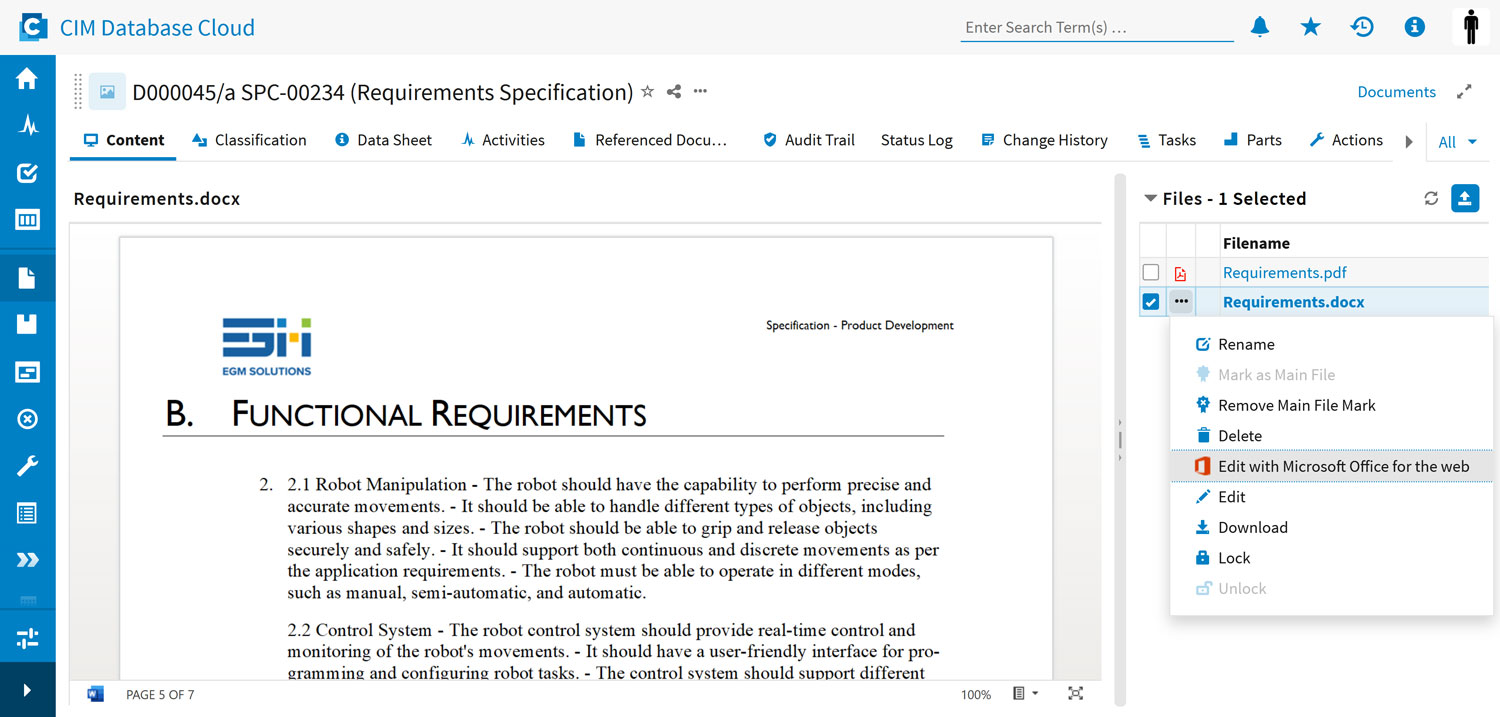
Microsoft Office for the web™ integration in Cloud PLM

How the integration simplifies document management in Cloud PLM

Pioneering technologies and digital innovations are shaping today’s economy. Seamless collaboration within companies is an essential factor for success. Product Lifecycle Management (PLM) supports this and helps increase efficiency. This is where the integration of Microsoft Office for the web™ in Cloud PLM comes into play. The integration of PLM systems and Microsoft Office not only promises an optimized way of working but also a smooth workflow that takes collaboration and productivity to a whole new level.

In this interview, André Guldi, Product Manager Cloud at CONTACT Software, explains the differences between document management with MS Office and in Cloud PLM, as well as the benefits of integrating Office for the web™.

André, how does document management differ in MS Office and Cloud PLM?

AG: MS Office has become the standard for creating documents, spreadsheets, and presentations because of its ease of use and extensive editing capabilities. However, documents are usually stored at the file level, which can lead to an unstructured data landscape. There is often no proper version control, leading to confusion and uncertainty about which documents are up-to-date. Many copies of the same document can be in circulation at a company, which makes collaboration and traceability difficult.

In Cloud PLM, this is different: its document management functionality offers a comprehensive solution. It establishes a “Single Source of Truth” for any type of document – a central, reliable storage location for documents. Managing metadata and file attachments allows for the structured organization and quick identification of documents. Additionally, extensive versioning, release workflows, and access control enhance document control. Search functions not only scan file names but also metadata and, using full-text search, even the content of the files. This simplifies finding documents and saves valuable time. Another significant advantage of document management in Cloud PLM is audit-safe storage. It is clear to users at first glance which document is currently valid, thus avoiding confusion or incorrect use.

What is Microsoft Office for the web™?

AG: Microsoft Office for the web™ (formerly Office Web Apps) is a web-based application that facilitates working with Office files. It allows users to open Word, Excel, OneNote, and PowerPoint documents directly in a web browser. The device used only requires a supported browser, an active internet connection, and users need a suite license. This allows them to use the full functionality of the web-based Office applications. This license not only allows them to gain access to documents but also to edit and share them with others – conveniently through the web browser without installing the Office Suite on their computer.

What are the benefits of integrating Office for the web™ into Cloud PLM?

AG: Microsoft Office for the web™ is seamlessly integrated into the Cloud PLM web interface. This allows users to create, view, and edit Office documents directly without the need to save them separately. They are saved in the Cloud PLM file storage, also known as Blobstore. This feature allows multiple people to work on the same document simultaneously without relying on local installations of MS Office.

A key feature is that only a single file exists, which simplifies file management and ensures a clear structure. The solution combines the advantages of an online Office editor with centralized and legally compliant document management in the PLM system: avoiding additional programs, eliminating file transfers, and enabling collaborative editing with version tracking, release workflows, and access control. This ensures efficient and secure document management.

What makes the connection between Office for the web™ and CIM Database Cloud special?

AG: CONTACT Software is the first software provider to offer the Office for the web™ integration in a Cloud PLM system. To edit an Office document in CIM Database Cloud, customers need an Office for the web™ suite license.

Conclusion

Microsoft Office for the web™ provides companies with an efficient solution for document management. It enables users to directly create, view, and simultaneously edit Office documents. The integration saves files directly in the Cloud PLM file storage, promotes collaborative work without local MS Office installations, and ensures a clear structure through a single file. This solution combines the advantages of an online Office editor with centralized document management in the Cloud PLM system, including versioning, release workflows, and access control for efficient and secure document management.

Discover CIM Database Cloud now – the first Cloud PLM system that enables the seamless integration of Microsoft Office for the web™.

Sustainable PLM through a cloud-based solution

Why Cloud PLM is the more sustainable choice

The Paris Agreement has a clear objective: limiting global temperature rise to below two degrees Celsius. To achieve this goal, companies must reduce their carbon footprint significantly. One promising way to enhance the resource efficiency of the employed Product Lifecycle Management (PLM) system is by utilizing cloud services. The shift to the cloud can be likened to carpooling, where the company’s on-premises server is akin to one’s own vehicle. In this example, it consumes substantial resources in the form of power to remain constantly operational. Cloud service providers act as carpools, sharing resources with multiple parties, eliminating the need for individual companies to operate extensive infrastructures. This not only saves resources but also enhances efficiency.

Discover why PLM in the cloud is the more sustainable choice compared to on-premises PLM software in this blog post.

On-premises versus cloud operation of PLM systems

On-premises or in the cloud – the operating models of PLM systems exhibit significant differences:

In on-premises operation, an internal server of the company hosts the PLM software, requiring capital-intensive investments in proprietary hardware and software. Local infrastructure is subject to a fixed capacity, potentially leading to bottlenecks during peak demand. Companies bear the responsibility for managing, maintaining, securing, and upgrading the PLM system themselves. Implementing new features or updates also requires a considerable lead time.

In contrast, cloud operation relies on an external provider to supply the server infrastructure. The cost structure is typically based on regular licensing fees. Cloud PLM systems are scalable, allowing resources to be flexibly adjusted based on demand. Management, maintenance, security, and system updates are the responsibility of the cloud provider. Compared to the companies using the PLM system, cloud providers possess more comprehensive expertise and state-of-the-art security technologies. New features or updates are implemented faster, given the external management of infrastructure and automatic updates.

3 Factors enable sustainable PLM in the cloud

Efficient resource utilization through cloud technology:

Server capacity, storage space, and network bandwidth can be efficiently managed in Cloud PLM software. The scalable cloud infrastructure allows PLM systems to adapt to specific requirements, such as adding or removing users. Scaling ensures optimal resource utilization while preventing energy waste.

Cloud providers also invest in efficient data centers and employ technologies like virtualization to maximize energy efficiency. This enables multiple virtual systems, operating systems, and applications to run on a single server. Consolidating servers and sharing hardware reduces energy consumption compared to decentralized software deployment. Advanced cooling technologies and intelligent energy management systems contribute to efficient resource utilization in data centers.

Using cloud services also reduces the need for local hardware such as servers, storage devices, and network equipment, resulting in less electronic waste and reduced demand for raw materials for new devices.

Dynamic load distribution in the cloud also contributes to overall efficiency. Traffic management flexibly adjusts to the performance needs of PLM applications to avoid network overloads.

Selection of sustainable cloud providers:

PLM in the cloud is particularly sustainable when chosen cloud providers use renewable energy sources. By leveraging solar power, wind energy, or hydropower, these companies reduce their ecological footprint.

Centralized updates and maintenance:

Cloud PLM providers centrally perform automated software updates and maintenance. This reduces the need for manual interventions at customer sites, which saves time, resources, and travel expenses.

Conclusion

In comparison to the local deployment of PLM software, the cloud enables more efficient resource utilization through flexible scaling, increased energy efficiency, and a reduced carbon footprint. Operating PLM systems in the cloud is more sustainable than on-premises when companies choose a cloud provider that uses renewable energy. Learn more about PLM and sustainability on our website.

CIM Database Cloud can be flexibly scaled up or down and is hosted on Amazon Web Services (AWS), which aims to operate entirely on renewable energy by 2025.