
How intuitive CAE apps accelerate product development

Today, companies face multiple challenges in launching increasingly complex products to the market faster. In particular, the lack of specialized knowledge available from simulation experts in the field of computer-aided engineering (CAE) often slows down product development. Easy-to-use CAE applications can remedy this situation and significantly improve the way products are developed and optimized.

Isolated expertise as a bottleneck in product development

However, daily practice reveals that answering supposedly simple questions, such as the effects of a material change on the deformation behavior of a component or the functional consequences of minor, production-related changes to the component geometry, via simulation, still demands significant organizational effort.

Complex issues require the exchange of numerous pieces of information between the involved process partners. Examples of this include providing current CAD statuses on the part of the design department or feeding back existing test results into the simulation. In addition, relevant decision deadlines and available simulation capacities must be considered. The execution and evaluation of the simulation usually demands specialized expertise, often isolated in expert groups and only available to a limited extent.

Providing access to expert knowledge throughout the organization

Therefore, the goal should be to break down barriers to using simulation technologies, making them accessible to a broad user group – regardless of their technical expertise. The way to achieve this can be termed as “technical democratization of simulation”. It involves integrating existing technical know-how into intuitive CAE applications and making them available to all users company-wide through a CAE business layer.

Three steps to the CAE business layer:

  1. Analysis
    The initial step involves a thorough inventory of the existing CAE processes within the company. This helps to identify the most important processes based on their relevance to the application and to decide which ones are suitable for the development of a CAE application according to the cost-benefit principle.
  2. Standardization
    The next step is the standardization of the identified CAE processes which needs the expertise of the calculation engineers. The requirements for the input factors of the CAE process, such as necessary parameters and data, as well as the desired output from the CAE process, are clearly defined. Since simulation processes are typically a complex interplay of different software tools, particular attention is paid to error handling in case potential issues arise during the ongoing process.
  3. Automation
    Subsequently, the CAE application is developed and implemented in the company. Deployment on a software platform available throughout the company, which also hosts the data required and generated for the process, ensures comprehensive traceability

Successively, a CAE business layer is created which unites the CAE applications.
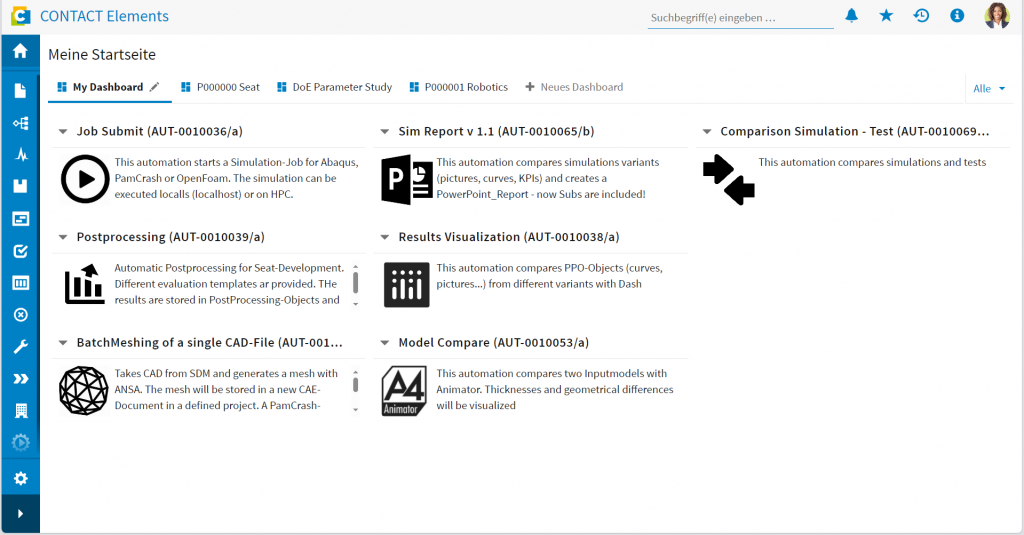
CAE apps dashboard in CONTACT Elements (© CONTACT Software)

Concerns and opportunities

Broad access to simulation technologies does not mean everyone becomes an expert but users are guided through complex processes. An integrated error-handling system reacts to incorrect inputs or deviations in the expected data. Experience shows that expert skills and simulation expertise are not devalued. On the contrary, experienced engineers with a wealth of practical experience and methodological know-how remain indispensable. Through general usage, they can focus on more challenging tasks, accompany decision-making processes, or concentrate on the advancement of simulation methods.

Conclusion: User-friendly CAE applications combine efficiency and innovation

The company-wide provision of user-friendly CAE applications marks an opportunity to establish simulation methods even earlier and more consistently in product development. More users are involved in the process, utilization of resources improves, innovations can be advanced more efficiently and enhanced products will be brought to market in less time. At the same time, it allows simulation experts to focus on more demanding tasks.

Accelerating product development with cloud DevOps

Leveraging the synergies of DevOps and cloud services for efficient product development

Accelerating product development all the way to market maturity is crucial for companies. Customers expect continuous innovation, while technological advancements quickly become outdated and product life cycles are getting shorter.

Cloud DevOps (Development and Operations) helps companies significantly reduce development times through automated processes, preconfigured tools, and agile collaboration.

André Guldi, Product Manager Cloud at CONTACT Software, explains how you can leverage the synergies of DevOps and cloud services for increased efficiency in product development.

1. Mr. Guldi, what are DevOps?

AG: In the allocation of work in software development, there has traditionally been an emphasis on departments. Developers wrote the code, which the quality management would then test. Afterward, IT was responsible for integrating the libraries into the production software.

DevOps breaks down the traditional separation between development and system design (Dev) and operation (Ops). Instead of three large teams, each responsible for their own tasks, this approach aims to bring experts from different areas together in small DevOps teams. This allows developers to gain a better understanding of the infrastructure, as well as the user-friendliness and testability of their code. At the same time, IT operations experts gain deep insights into development and testing processes.

DevOps integrates development and operations in agile teams. It provides an automated and standardized process that is qualified and documented, enabling faster software development and implementation.

2. What are the specific benefits of DevOps?

AG: The close collaboration between development and operations in agile DevOps teams offers the following advantages:

  1. Faster implementation: Thanks to seamless collaboration between teams in an agile development environment with efficient automation tools, applications can be deployed faster, and updates rolled out continuously.
  2. Risk mitigation: Through continuous integration and ongoing testing, errors and security risks are detected and fixed before they affect the production environment. In addition, applications can be automatically restored after a crisis event.
  3. Cost reduction: Automating development, testing, and deployment processes reduces manual efforts for recurring tasks. This saves time, resources, and money.
  4. Quality improvements: The close collaboration in agile DevOps teams improves coordination and ensures a deeper understanding of the requirements. Additionally, continuous integration and automated testing guarantee high software quality that meets user expectations.

3. How are DevOps and cloud services connected?

AG: DevOps and cloud technologies are symbiotic. The cloud enables us to automate, standardize, and replicate entire infrastructures. In combination, this extends the DevOps approach from development practices and testing applications to the agile deployment of infrastructures. Integrating the mentioned DevOps advantages into a flexible and scalable cloud environment that allows for resources to be adjusted according to demand provides a tremendous boost in software development. This way, cloud services and infrastructures can be deployed, configured, and – if necessary – shut down in a very short time.

4. What DevOps services does CONTACT provide to users of CIM Database Cloud?

AG: CIM Database Cloud offers customers the ability to configure and manage applications according to their preferences. For this purpose, CONTACT provides various preconfigured tools on the cloud platform, such as Git, Automation Pipelines, Docker Images, and many others. With these tools, customers can implement proven DevOps processes. For example, they can upload their customizations to a central Git server, validate changes in test environments, and then deploy them to the production environment.

Predefined Continuous Integration (CI) / Continuous Deployment (CD) pipelines help automate the process. Additionally, specific dashboards are available to monitor the various steps and results of these processes.

The DevOps Services of CONTACT Software

Conclusion

CIM Database Cloud integrates the DevOps process and systematizes development and operational processes. Automated testing, preconfigured tools, and improved collaboration accelerate development cycles, identify errors early in the process, and allow rapid adjustments. Companies benefit from more efficient processes, faster iterations, and can better respond to their customers’ needs.

Whether you already use a customized PLM system or are looking to implement a new one, our integrated DevOps service enables a wide range of customizations, testing, and deployments – seamlessly and directly in the cloud.