How PLM paves the way for sustainable product development

In today’s sustainability-driven world, ensuring transparency and traceability across the entire product lifecycle is crucial. Product Lifecycle Management (PLM) helps to tackle these challenges by providing a solid data foundation for informed decisions.

Challenges for companies: regulations and customer demands

Companies are often faced with regulatory challenges that influence the development of strategies and products. The European Green Deal and the Corporate Sustainability Reporting Directive (CSRD) provide a corresponding framework. At the same time, customers demand solutions that support sustainable product development, and the call for a green transformation grows louder. But how can companies take this step?

Companies in the green transition

The green transition is a monumental task for the industry. Sustainable development, as defined by the 1987 Brundtland Report, becomes a guiding principle. The goal is to meet the needs of the present without compromising the needs of future generations. With sustainable design as a core element of this movement, economic and ecological dimensions are aligned. Unlike approaches like Eco-design, Sustainable Design also integrates ethical aspects, human rights, and social justice, such as social aspects in the supply chain.

PLM as a key for sustainable product design

Every product goes through various lifecycle phases where decisions regarding material selection, design, and manufacturing processes are made. PLM systems like CIM Database PLM enable the consideration of sustainability principles as early as the design phase. Reducing waste, efficient use of energy, and recycling become integral parts starting from early design processes.

Read more about how PLM contributes to sustainable product development here.

Life Cycle Assessment (LCA) and PLM: An unmatched combination

Life Cycle Assessment (LCA) is another central approach for the evaluation of environmental impacts. By quantifying and assessing environmental impacts across the entire lifecycle of a product, companies can identify environmental aspects and potential effects.

PLM as a structural guide for sustainable products

The product structure, also known as Bill of Materials (BOM), is utilized by PLM as a structured guide. It enables accurate assessment of environmental impacts across the entire product range. Material properties, work schedules, and data aggregation support the selection of sustainable materials.

Material Compliance: Mastering regulations more easily

The selection of materials must not only be environmentally friendly but also legally compliant. This is where Material Compliance comes into play. A PLM system enables the management of product structures and material data as well as a smooth implementation of material compliance through the traceability of used materials.

Digital Product Passport for the circular economy

Transparency about materials and products is crucial for a successful circular economy. The Digital Product Passport acts as a carrier of information from the PLM system and provides a foundation for GHG reporting. The Asset Administration Shell (AAS) serves as a standardized technology for information exchange.

PLM for a sustainable future

Through a holistic view of the lifecycle, impacts and risks can be detected, assessed, and ultimately avoided at an early stage. CONTACT Research is committed to more sustainable product development in order to shape a harmonious future. Let’s tackle the challenges of sustainable product development together and leave a positive impact on the world!

Read the full article on the CONTACT Research Blog here.

Sustainable PLM through a cloud-based solution

Why Cloud PLM is the more sustainable choice

The Paris Agreement has a clear objective: limiting global temperature rise to below two degrees Celsius. To achieve this goal, companies must reduce their carbon footprint significantly. One promising way to enhance the resource efficiency of the employed Product Lifecycle Management (PLM) system is by utilizing cloud services. The shift to the cloud can be likened to carpooling, where the company’s on-premises server is akin to one’s own vehicle. In this example, it consumes substantial resources in the form of power to remain constantly operational. Cloud service providers act as carpools, sharing resources with multiple parties, eliminating the need for individual companies to operate extensive infrastructures. This not only saves resources but also enhances efficiency.

Discover why PLM in the cloud is the more sustainable choice compared to on-premises PLM software in this blog post.

On-premises versus cloud operation of PLM systems

On-premises or in the cloud – the operating models of PLM systems exhibit significant differences:

In on-premises operation, an internal server of the company hosts the PLM software, requiring capital-intensive investments in proprietary hardware and software. Local infrastructure is subject to a fixed capacity, potentially leading to bottlenecks during peak demand. Companies bear the responsibility for managing, maintaining, securing, and upgrading the PLM system themselves. Implementing new features or updates also requires a considerable lead time.

In contrast, cloud operation relies on an external provider to supply the server infrastructure. The cost structure is typically based on regular licensing fees. Cloud PLM systems are scalable, allowing resources to be flexibly adjusted based on demand. Management, maintenance, security, and system updates are the responsibility of the cloud provider. Compared to the companies using the PLM system, cloud providers possess more comprehensive expertise and state-of-the-art security technologies. New features or updates are implemented faster, given the external management of infrastructure and automatic updates.

3 Factors enable sustainable PLM in the cloud

Efficient resource utilization through cloud technology:

Server capacity, storage space, and network bandwidth can be efficiently managed in Cloud PLM software. The scalable cloud infrastructure allows PLM systems to adapt to specific requirements, such as adding or removing users. Scaling ensures optimal resource utilization while preventing energy waste.

Cloud providers also invest in efficient data centers and employ technologies like virtualization to maximize energy efficiency. This enables multiple virtual systems, operating systems, and applications to run on a single server. Consolidating servers and sharing hardware reduces energy consumption compared to decentralized software deployment. Advanced cooling technologies and intelligent energy management systems contribute to efficient resource utilization in data centers.

Using cloud services also reduces the need for local hardware such as servers, storage devices, and network equipment, resulting in less electronic waste and reduced demand for raw materials for new devices.

Dynamic load distribution in the cloud also contributes to overall efficiency. Traffic management flexibly adjusts to the performance needs of PLM applications to avoid network overloads.

Selection of sustainable cloud providers:

PLM in the cloud is particularly sustainable when chosen cloud providers use renewable energy sources. By leveraging solar power, wind energy, or hydropower, these companies reduce their ecological footprint.

Centralized updates and maintenance:

Cloud PLM providers centrally perform automated software updates and maintenance. This reduces the need for manual interventions at customer sites, which saves time, resources, and travel expenses.

Conclusion

In comparison to the local deployment of PLM software, the cloud enables more efficient resource utilization through flexible scaling, increased energy efficiency, and a reduced carbon footprint. Operating PLM systems in the cloud is more sustainable than on-premises when companies choose a cloud provider that uses renewable energy. Learn more about PLM and sustainability on our website.

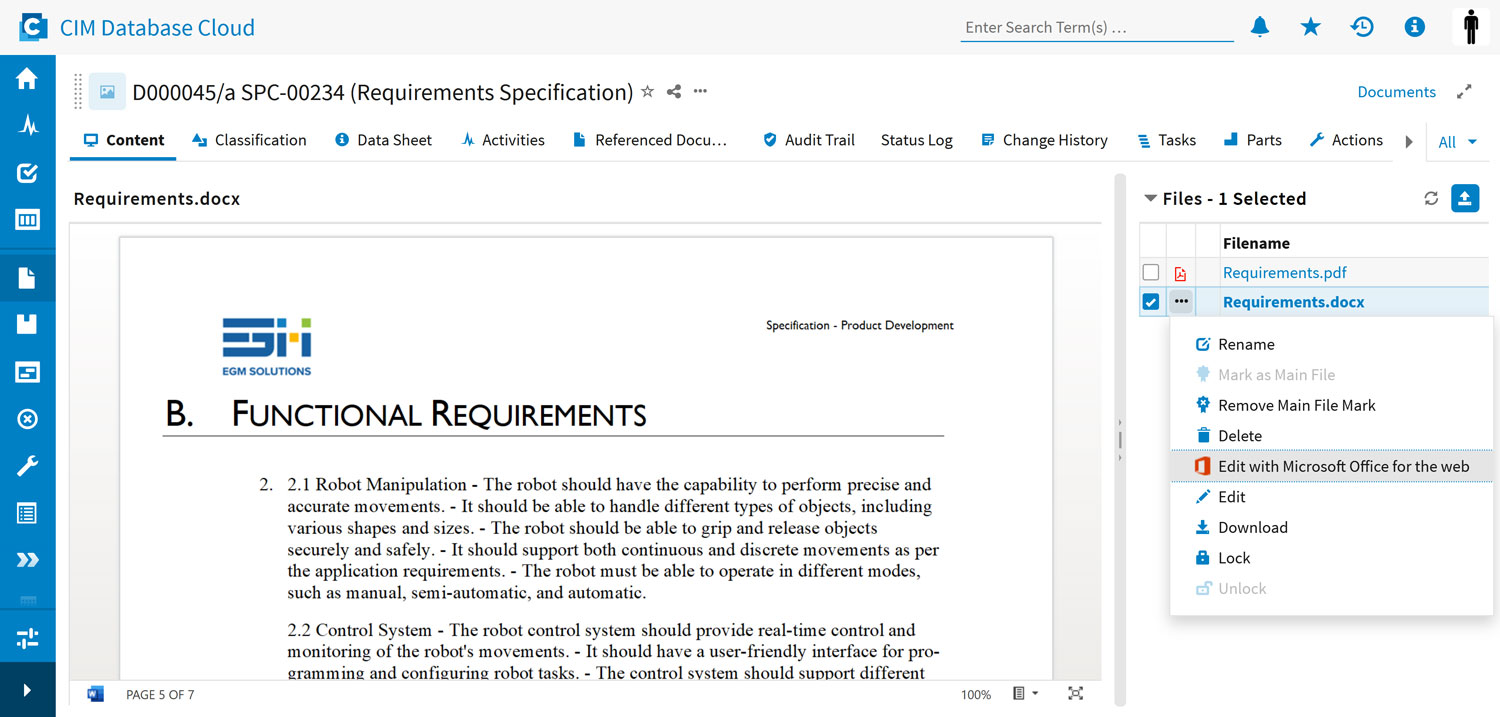
CIM Database Cloud can be flexibly scaled up or down and is hosted on Amazon Web Services (AWS), which aims to operate entirely on renewable energy by 2025.

The importance of user experience for Cloud PLM

Factors and features improving usability

In an increasingly digitalized world, cloud-based solutions for Product Lifecycle Management (PLM) play a crucial role in efficiently managing product data and processes. A number of providers develop Cloud PLM software. Apart from functionalities and pricing, the user experience (UX) holds particular importance as it significantly influences user acceptance.

In this blog post, you will learn why selecting user-friendly Cloud PLM software is essential and what considerations you should keep in mind.

Why UX is important

When it comes to software, a well-designed user experience is not just a nice-to-have but a crucial factor that significantly influences how users perceive a tool, adapt and use it. Here are 5 reasons why you should prioritize user-friendliness when choosing Cloud PLM software:

  1. User satisfaction: A well-conceived user experience increases user satisfaction. When users intuitively understand a software and find interacting with it pleasant and rewarding, they are more inclined to use it again.
  2. Efficiency and productivity: A compelling user interface and meaningful interaction options enable users to complete tasks faster and more effectively.
  3. Error reduction: A thoughtful UX helps minimize errors. Clear instructions, easy navigation, and consistent design elements lead to users making fewer mistakes and finding solutions faster when errors do occur.
  4. Accessibility: A good UX takes into account the diversity of the user base and includes people with different abilities and limitations. Accessible designs allow everybody to work with the software without barriers.
  5. Cost-Efficiency: Software with an intuitive UX can save costs in the long run, as users make fewer mistakes and the need for support and training decreases.

Cloud PLM and the challenges of user-friendliness

Cloud PLM systems enable centralized management of product information in real time, promoting collaboration and efficiency. Nevertheless, they initially pose some challenges for new users: they have to familiarize themselves with a new user interface, learn how to use complex functions, and handle data from a variety of sources. A sophisticated UX helps overcome these challenges:

Intuitive user interface: The user interface should be simple and intuitive to enable quick familiarization. A clean design and well-placed features help users navigate easily.

Customized dashboards & charts: Custom dashboards and time schedules allow users to see information and functions relevant for their tasks at a glance. Gantt charts, for example, provide a clear overview of project progress, aid in identifying task dependencies, and simplify resource planning.

Collaboration tools: A high-quality Cloud PLM platform should offer seamless collaboration features. Comment functions, real-time collaboration, and shared editing options are crucial for facilitating communication and information exchange.

Search and filter functions: Efficient search and filter functions, including an enterprise search, help users quickly access needed information. This is especially crucial with large datasets.

Integration with other systems: Seamless integration with other enterprise systems like ERP or CAD dissolves data silos and ensures all relevant data are linked.

User guidance and training: Well-structured tutorials and training materials assist users in utilizing the software to its full potential. A carefully crafted onboarding strategy is crucial to achieve a flat learning curve.

Feedback mechanisms: Users should be able to provide feedback for continuous software improvement. A dedicated community serves as an ideal platform for an open dialogue between developers and users.

Conclusion

For Cloud PLM software, an excellent user experience is not an option but a necessity. It enhances productivity, cost-efficiency, and user satisfaction. The entire team, including members with disabilities, can effortlessly and efficiently work with the tool. User-friendly Cloud PLM systems offer intuitive interfaces, customizable dashboards, collaboration tools, search and filter functions, training and feedback options, as well as integrations with third-party systems.

CIM Database Cloud provides state-of-the-art PLM features combined with an intuitive user interface and a flat learning curve.