
CAD visualization in Cloud PLM

The benefits of an integrated 3D viewing solution 

As a CAD designer, you surely remember the impractical blueprints, the endless meetings, and the guesswork about how part A should actually fit together with part B. With CAD visualization, those days are finally over. 

In digital product development, fast and straightforward access to CAD models is crucial. Often, companies face the challenge that CAD models can only be opened and analyzed with special viewers or expensive CAD licenses. This is where the 3D viewer integrated into Cloud PLM comes in – an innovative solution that allows you to visualize, analyze and annotate CAD models. 

We will explain here the advantages a 3D viewer offers and why it makes sense to be directly integrated in Cloud PLM: 

What is a 3D Viewer?

The 3D viewer is a web-based application that allows CAD models to be displayed, measured, and annotated in three dimensions. The solution opens up new possibilities for collaboration between engineers, designers, suppliers and other stakeholders. 

Applications for CAD visualization

  • Product development: Designers and engineers can analyze and improve models faster.
  • Supplier and customer communication: Models can be shared and discussed without partners needing special CAD software.
  • Quality assurance: Testing and approval processes are accelerated by direct measurement in the cloud and the commenting function.
  • Technical support and maintenance: Technicians can access 3D models to identify spare parts or perform repairs.

Advantages of 3D viewers Integrated directly into Cloud PLM

1. Cross-CAD system support:

The 3D viewer can display models from different CAD systems, for example, SolidWorks, CATIA, Siemens NX, or Autodesk Inventor. No native software is needed for this. 

2. No CAD viewer licenses required:

Access to CAD models is often associated with high licensing costs. 3D viewers integrated in Cloud PLM eliminate this hurdle, as no additional licenses are required. This saves costs and makes it easier to provide the software to a large group of users. 

3. Measurement and analysis:

With the 3D viewer, users can measure models directly in the cloud, create cross-sections, and perform analyses. This enables a quick verification of dimensions and tolerances even without access to a CAD system. 

4. Collaborative annotation and feedback:

The tool allows users to leave comments and annotations on specific areas of a 3D model. Teams collaborate more efficiently and discuss changes directly on the object. 

5. Easier tracking of version status:

The 3D viewer is fully integrated into a cloud-based PLM system. CAD models are called up and edited from within the PLM software. This facilitates management and ensures access to the correct version status. 

What is CONTACT Elements 3D Connect?

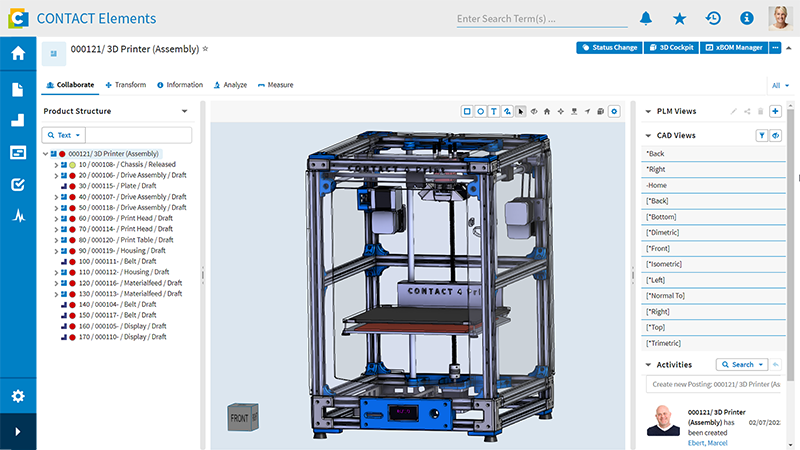
CONTACT Elements 3D Connect offers a comprehensive 3D visualization solution that is integrated into the CIM Database Cloud PLM system. Employees from other specialist departments do not need to install any additional software, but use the viewer directly via the cloud platform. The tool automatically generates a 3D representation based on the checked-in CAD models and offers direct access to CAD model data, parts, variants, product structures and bills of materials. You can use measuring functions, exploded views and redlining and save snapshots of selected views. Color codes reflect component properties such as the release status directly in the model. 
Conclusion

The integrated 3D visualization in Cloud PLM removes barriers, reduces costs, and accelerates processes. Cross-CAD system support, the elimination of licenses, as well as the analysis and commenting functions simplify collaboration between all parties involved and increase efficiency. Integration into a cloud-based PLM system ensures that the latest version statuses are always available and product development is optimally supported. 

Learn more about the possibilities of 3D Collaboration in CIM Database Cloud.

ISO 27001 & Cloud PLM: reliably protecting product data

Why certification should be considered when choosing a system

A PLM system stores a wide range of sensitive product data — from the first sketch to the finished product. What happens if this data falls into the wrong hands? Or if third parties manipulate the information?

Companies can avoid such risks using certified Cloud PLM software according to ISO 27001. The certification follows globally recognized standards that ensure information security at all times.

In this blog post, you’ll learn why ISO 27001 certification is an important criterion when selecting a cloud-based PLM system. You’ll also get an insight into the processes and methods certified providers use to protect your data.

What is ISO 27001 Certification?

ISO/IEC 27001 is an international standard that defines the requirements for an Information Security Management System (ISMS). An ISMS includes policies, procedures, and technical measures that systematically protect information within an organization.

The ISMS defines three security objectives:

• Confidentiality: Only authorized persons are allowed to access sensitive information. Measures like encryption, access control lists, and file permissions ensure confidentiality.

• Integrity: Only authorized persons can modify data. It must be ensured that unauthorized changes can be undone.

• Availability: Information must always be accessible to authorized users. Risks like power or network outages are taken into account.

Independent certification bodies carry out the ISO 27001 certification. Key requirements include:

• Risk assessment and management: Identification of potential threats and vulnerabilities.

• Security Policies: Establishing clear guidelines for handling information.

• Training: Raising awareness among employees about information security.

• Continuous improvement: Regular reviews and optimization of security measures.

Advantages of ISO 27001 Certification for Cloud Providers

1. Trustworthiness and Transparency

ISO 27001 certification shows that the cloud provider follows high security standards, handles data with maximum care, and proactively addresses potential risks.

2. Risk Minimization

Companies that store sensitive data in the cloud need adequate protection against cyberattacks, data loss, and unauthorized access. ISO 27001 certification proves that the provider has implemented effective protective measures.

3. Compliance and Legal Requirements

Since certified cloud providers already meet crucial security standards, it’s easier for customers to comply with data protection and security regulations such as the EU General Data Protection Regulation (GDPR).

4. Efficient Risk Management

ISO 27001 provides structured risk management processes. They help systematically identify, minimize, and address vulnerabilities early and reliably.

Conclusion

Cyberattacks caused economic damage of 266 billion euros in Germany alone in 2024. When selecting software such as Cloud PLM, IT security should be one of the key criteria. ISO 27001 certification signals to companies that their data is comprehensively protected. It follows reliable security standards and facilitates compliance with legal requirements.

The development and operation of cloud products based on CONTACT Elements meet the strict requirements of the ISO 27001 standard. This certification confirms that CIM Database Cloud meets the highest security standards and ensures effective management of information security risks.

Using SCIM in Cloud PLM Systems

Efficient User and Access Management in Product Lifecycle Management

As companies grow, drive innovation, and navigate staff changes, the number of user accounts naturally increases. Every tool — whether for customer management or team collaboration — requires its own user account. This poses a significant challenge for the IT department, as every request, such as adding new users or modifying permissions, consumes valuable resources. This effort can be minimized with SCIM (System for Cross-Domain Identity Management) — efficiently, securely, and user-friendly.
In this article, learn how SCIM facilitates the entire process of managing user data in Cloud PLM systems through automated identity lifecycle management.

What is SCIM?

SCIM is an open standard designed to facilitate the exchange and synchronization of user data and permissions across different applications and systems. It was developed to minimize administrative effort in managing user data while enhancing security.
SCIM allows organizations to manage user accounts centrally. Related information is automatically transferred to other applications, such as Cloud PLM systems.

Why is SCIM important for Cloud PLM Solutions?

Without an automated solution like SCIM, companies face two challenges when managing user data and access rights in Cloud PLM systems:
• High manual effort: Users must be created, updated, or deleted individually across multiple systems.
• Security risks: Outdated user accounts in PLM systems can create security vulnerabilities.

What are the Benefits of using SCIM in Cloud PLM Systems?

SCIM significantly reduces the effort required to manage user accounts. It seamlessly connects identity management systems with enterprise applications, eliminating the need to develop and maintain custom integrations.
This relieves the IT department and employees in other departments benefit from Single Sign-On (SSO). With a single login, they gain access to all necessary applications. This streamlines workflows and reduces password reset requests by up to 50%. By minimizing administrative tasks, more time is available for core tasks. Automated synchronization ensures that user data remains up-to-date and consistent across all systems.
Security also increases significantly in combination with Single Sign-On. Thanks to centralized SSO authentication based on OpenID Connect (OIDC), there’s no need to have a separate password for each account. This reduces security risks related to weak or reused passwords. Companies can enforce security policies more consistently and integrate new workflows or applications more easily. At the same time, they maintain full control over user accounts.

Can Companies use the SCIM Interface with CIM Database Cloud?

The SCIM interface is now available for CIM Database Cloud. It is part of the CIM Database Cloud infrastructure and does not incur additional licensing costs.

Conclusion

SCIM is a standard that automatically synchronizes user data and permissions across different systems. By integrating SCIM into Cloud PLM solutions, companies can streamline their processes, reduce security risks, and minimize administrative overhead.
Take advantage of the benefits of cloud-based PLM software now: CIM Database Cloud is the solution for end-to-end digital product development with an integrated SCIM interface.